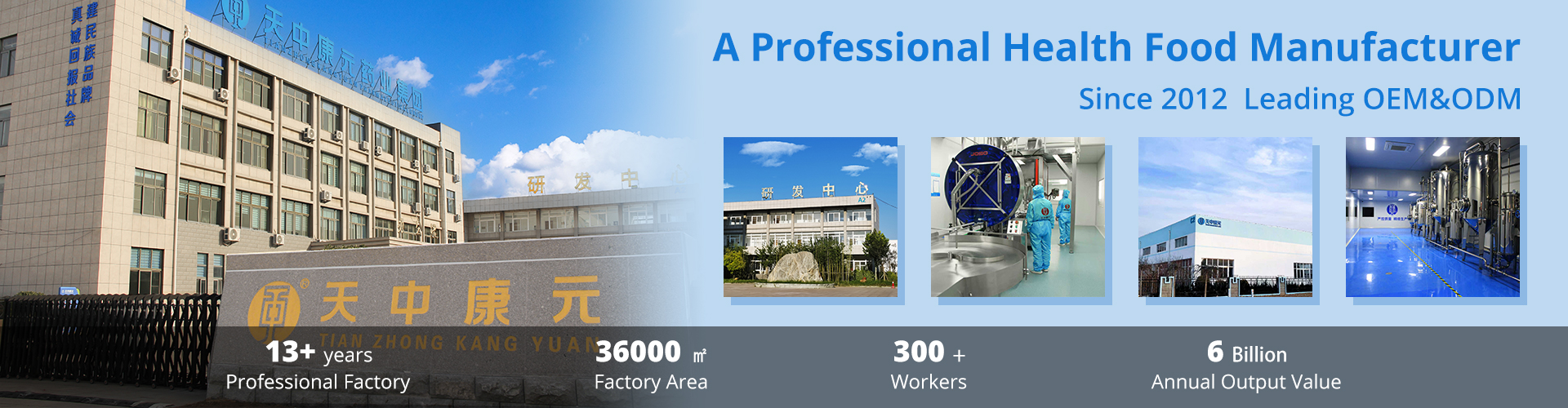
A GMP gummy vitamins factory is defined not by a certificate on the wall but by daily adherence to documented procedures, deviation management, and continuous improvement. Tianzhong Kangyuan Pharmaceutical Group Co., Ltd operates as a GMP gummy vitamins factory that has passed 14 separate GMP audits in 2025 alone—including those from major retailers, government health authorities, and third-party certification bodies.
Manufacturing Strength Under GMP Protocols
The group's 168,000㎡ production campus implements a closed-loop GMP system covering 147 standard operating procedures, each with annual review and revision tracking. Unlike facilities that apply GMP only to production, Tianzhong Kangyuan extends protocols to warehousing (temperature/humidity logging every 15 minutes), water purification (daily conductivity and TOC testing), and personnel hygiene (swab testing of gloved hands before each shift). For multivitamin gummies, the factory uses color-coded tooling and dedicated transfer chutes to prevent cross-contamination between runs—a common GMP violation in standard facilities. Each of the ten continuous lines generates electronic batch records with real-time deviation alerts, reducing human transcription errors to zero across the last eight quarters. Annual GMP-compliant capacity reaches 9.2 billion pieces.
Research Capabilities Supporting GMP Compliance
The group's 8,200㎡ analytical laboratory operates under ISO 17025 accreditation, with 31 validated test methods specific to gummy matrices. A 2026 innovation involves a rapid microbiological method for vitamin gummies that reduces total plate count testing from 72 hours to just 6 hours using ATP bioluminescence with selective filtration—allowing same-day release decisions. For vitamin c gummies, the lab developed a stability-indicating assay that separates ascorbic acid from its oxidized form using a shorter column chemistry (15-minute run time vs. industry standard 30 minutes), doubling throughput without sacrificing resolution as required by GMP data integrity rules.
The R&D team also created a first-article inspection protocol for Wellness Gummies containing multiple botanicals, using near-infrared spectroscopy to verify each active ingredient's identity without destructive testing. This method has been cross-validated against HPLC for 47 unique formulae and accepted by three major GMP auditors as an alternative to traditional wet chemistry for incoming raw material testing.
Custom Solution Capabilities for GMP-Ready Production
Tianzhong Kangyuan's custom solution framework includes a "GMP readiness assessment" for each new client formula. This process maps every manufacturing step against GMP requirements, identifying potential risks such as powder bridging, inconsistent drying, or metal detector sensitivity mismatches before production begins. For a Canadian brand requiring multivitamin gummies with 11 minerals (including chromium picolinate and selenium), the team redesigned the blending sequence to prevent segregation of low-density ingredients, adding a pre-blend step with excipients to ensure uniformity across all 11 actives. The final product passed Health Canada's GMP inspection on the first attempt.
For an Australian client needing gummy vitamins for diabetic consumers (sugar-free, high-fiber), the factory engineered a modified tapioca fiber system that maintains gummy texture without crystallization—a known GMP issue for sugar-free formulations where improper moisture control leads to hardening. The custom solution included a revised drying protocol with 30% longer residence time and lower inlet air temperature. Another recent success involved vitamin c gummies with added rose hips and bioflavonoids, where the group implemented a dedicated cleaning validation protocol for the natural colorants that previously caused staining in shared equipment. All custom GMP projects include a deviation response plan, CAPA (Corrective and Preventive Action) templates, and annual GMP refresher training for client-facing quality teams.